Guide
Environmental and halogen-free expectations for interconnect
RoHS versus halogen-free versus customer blacklists for FFC and IRRAX wire — IRRAX B non-PBDE notes, SUMI-CARD HIGH-rating context, declaration hygiene, and formulation change control.
6 November 2026
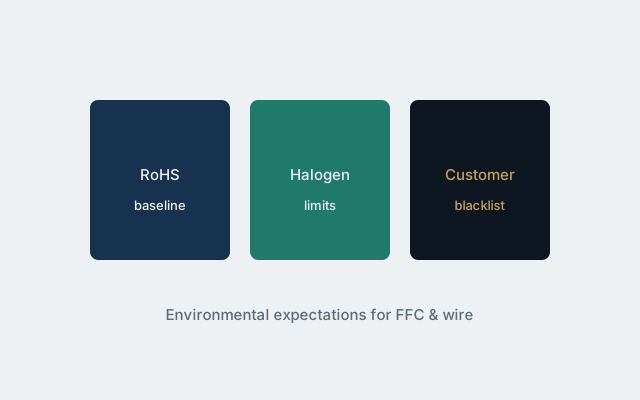
Environmental expectations on interconnect no longer collapse into a single checkbox marked “RoHS.” OEM programmes stack regulated substance limits, halogen-free policies, and proprietary customer blacklists on top of ordinary UL style and mechanical drawings. Flexible flat cable marketed as SUMI-CARD™ and irradiated wires marketed as IRRAX™ both sit inside that stack — sometimes with explicit halogen-free or non-PBDE messaging in archived catalogues, sometimes with thermoplastic constructions that still need full declarations.
This FFC & Wire Hub article separates the layers, explains what IRRAX B / non-PBDE and halogen-free FFC HIGH-rating notes usually mean in practice, and outlines declaration hygiene plus change management when formulations shift. Sumitomo Electric Interconnect Products Malaysia (SEPM) appears only as a brand and product-context reference. This site is an independent educational publisher; it is not an official Sumitomo or SEPM channel and does not issue compliance certificates.
Three layers that get conflated
1. RoHS-style restricted substances
RoHS (and related regional regimes) restrict specific hazardous substances in electrical and electronic equipment — historically lead, mercury, cadmium, hexavalent chromium, and certain brominated flame retardants (PBB and PBDE), with later additions such as selected phthalates under amended scopes. A “RoHS compliant” claim for a wire or FFC construction is a statement about those regulated substances (and exemptions if any), not a universal green passport.
Implications for interconnect:
- PVC and other halogen-containing polymers can still be RoHS-aligned if restricted additives are controlled.
- Lead-free conductor finishes and solderability notes are related but not identical to insulation chemistry claims.
- Exemptions, when used, must be named — silence is not an exemption strategy.
2. Halogen-free expectations
Halogen-free policies target chlorine, bromine, and sometimes fluorine-related metrics defined by the customer or by referenced industry documents (IEC / IPC-style guidance is commonly cited in OEM specs — always use the edition your contract names). The intent is often smoke corrosivity and toxicity behaviour in fire scenarios, plus corporate green-procurement branding.
Halogen-free is not automatically implied by RoHS. A construction can pass RoHS and still fail a halogen-free clause if the polymer system uses halogenated flame retardants or halogen-rich base resins beyond the allowed thresholds.
3. Customer blacklists and full-material disclosure
Large OEMs maintain proprietary banned / restricted substance lists that go beyond law. They may limit antimony compounds, specific plasticisers, red phosphorus under certain conditions, or entire additive classes. Full-material disclosure (FMD) or IMDS-style reporting is how automotive and some industrial programmes verify the claim.
Blacklists change. A declaration dated 2019 can be factually true for 2019 rules and still fail a 2026 OEM template.
Why interconnect is a frequent compliance bottleneck
Copper conductors are simple compared with insulation systems. Extruded wires combine base polymer, flame retardants, stabilisers, colourants, and print inks. Laminated FFC adds films, adhesives, possible shield metallisation, and plated terminations. Each layer can introduce a restricted substance or a halogen contribution.
Typical bottleneck moments:
- Late halogen-free requirements after mechanical drawings are frozen.
- Print ink or colour concentrate that was never included in the original declaration.
- Plating chemistry or gold-salt processes that affect other regulated metals even when insulation is clean.
- Shield foils and adhesives that were “invisible” on the marketing datasheet.
- Distributor-relabelled stock without a traceable manufacturer declaration.
Build substance requirements into the first RFQ, not into the week before mass production.
IRRAX families and environmental messaging
Archived IRRAX tables commonly distinguish:
- IRRAX V2 — lead-free oriented messaging on many rows; still confirm current RoHS packs.
- IRRAX HF — halogen-free oriented style families across voltage/temperature combinations.
- IRRAX B / B28 (non-PBDE type) — flame-retardant oriented constructions with explicit non-PBDE historical messaging.
- High-voltage halogen-free options — HV rows that combine elevated voltage with halogen-free polymer goals.
- Spiral shielded variants — add metal and possibly tape adhesives to the substance conversation.
Non-PBDE messaging answers a RoHS-era brominated flame retardant concern. It does not automatically equal halogen-free. Bromine and chlorine can appear through other chemistries; conversely, some halogen-free systems use alternative flame-retardant strategies that need their own blacklist review (for example, interactions with antimony or phosphorus rules in customer lists).
For chemistry and thermal behaviour of cross-linking itself, see IRRAX cross-linking. For family orientation, see the IRRAX product topic.
Practical reading of “HF” on a wire row
When a catalogue row says halogen-free:
- Ask which test method and limits the plant used (customer method vs internal method).
- Ask whether print, colour, and separator tapes are included in the claim.
- Ask whether the claim is per construction or a family blanket.
- Request a dated declaration on company letterhead or the OEM’s portal format.
- Align the UL style temperature/voltage needs separately — HF is not a voltage rating.
FFC halogen-free HIGH-rating notes
Flat Component messaging around SUMI-CARD™ historically includes halogen-free HIGH-rating constructions alongside fine-pitch, shielded, Au-plated, and high-temperature / high-humidity grades. In OEM practice, that usually means a laminated FFC stack engineered to meet elevated temperature or performance targets while satisfying a halogen-free substance goal — not a vague “greener ribbon.”
Selection notes:
- Halogen-free films and adhesives can change flex life and fold behaviour versus legacy halogenated stacks — validate dynamic routes again.
- Shielded halogen-free FFC still needs shield termination design for EMI; substance and EMI are parallel workstreams.
- HIGH-rating language is manufacturer marketing tied to specific constructions — put the numeric temperature, humidity, and substance limits on the drawing.
- Pitch and plating choices (including 0.5 mm class and Au ends) are orthogonal to halogen status; specify both.
See the SUMI-CARD topic page for construction families. Pair it with this guide when environmental clauses appear in the same RFQ as pitch and length.
Declaration hygiene — making paperwork match the part
What a usable declaration contains
- Legal manufacturer name and address matching the ship-from plant when possible.
- Exact product family / part number / construction code.
- Standards or OEM templates referenced, with editions/dates.
- Homogeneous material breakdown or at least substance thresholds as required by the template.
- Signature, name, title, and date.
- Reference to the bill-of-materials revision of the construction.
Hygiene failures to reject
- Undated PDFs with generic “all our products comply.”
- Declarations for a sister construction with a similar name.
- RoHS letters offered when the PO required halogen-free.
- Distributor statements with no manufacturer attachment.
- Screenshots of web pages instead of controlled documents.
Version control inside the OEM
Store declarations next to the approved drawing revision. When purchasing switches colour or spool length, re-check whether those are covered. When the supplier issues a new compound code with the same marketing name, treat it as a new part until the declaration is refreshed.
Change management when formulations shift
Flame-retardant and polymer markets move when regulations, costs, or supply shocks hit. Plants may reformulate while keeping a familiar IRRAX or SUMI-CARD marketing label. Without change control, your product quietly inherits new chemistry.
Contractual expectations worth writing down
- Prior written approval before changes to base polymer, flame retardant package, colourant, adhesive, plating, or manufacturing site.
- Minimum notification lead time (for example, 90–180 days) proportional to your qualification cycle.
- Obligation to update RoHS, halogen, and blacklist declarations before shipping the new formulation.
- Right to requalify flex life, dielectric, and appearance after material changes.
- Traceability of the first lots after a change with distinct lot coding.
Technical requalification triggers
Reformulation may affect:
- Cold bend and flex life of FFC.
- Insulation resistance after humidity bias.
- Solder pot or soldering-iron withstand near terminations on irradiated wire.
- Colour stability and print adhesion.
- Odour or outgassing in sealed consumer devices.
- Flame test behaviour even when substance thresholds still pass.
Do not assume “same UL style” means “same formulation.” Styles classify constructions; compounds still evolve.
Mapping requirements onto SEPM-class product pillars
Public SEPM division framing separates Flat Component (SUMI-CARD FFC, jumper leads, plating expansions) from Electronic Wires (PVC families, SUMIFLEX-type flexibles, IRRAX including HF and HV). Environmental clauses should be applied per pillar and per SKU, not as a campus-wide slogan.
Useful orientation pages:
- SEPM brand profile — campus and division context.
- IRRAX product topic — irradiated families including HF / B / HV notes.
- SUMI-CARD product topic — FFC variants including halogen-free HIGH-rating messaging.
- IRRAX cross-linking guide — why irradiated insulation is chosen beyond substance goals.
Remember: FFC & Wire Hub summarises public product language for education. Always confirm live declarations with the manufacturer.
Writing environmental requirements into drawings and POs
Ambiguous notes create disputes. Prefer precise clauses:
Insulation and associated polymeric materials shall meet [OEM halogen-free spec ID, rev]. Deliverables include a dated manufacturer declaration covering insulation, jackets, adhesives, colourants, and print inks. RoHS compliance per [directive/edition] shall be declared separately. Customer blacklist [doc ID, rev] applies. No material or plant change without prior written approval.
Avoid:
Must be environmental friendly / green wire.
Also separate packaging substance rules (trays, desiccants, labels) if your corporate template requires them — interconnect declarations sometimes omit packaging intentionally.
Lab testing vs declaration — when to spend the money
Declarations are the baseline. Independent lab testing is warranted when:
- The programme is automotive, medical, or otherwise high-liability.
- The supplier is new or the plant is newly added to the AVL.
- A formulation change is proposed.
- Halogen-free claims are critical to a public OEM environmental label.
- Historical paperwork quality has been weak.
Agree sampling plans in advance: which lots, which methods, who pays, and what happens on failure. Random “gotcha” testing without a contract framework creates conflict without improving control.
Interaction with flame ratings and UL styles
OEMs sometimes ask for halogen-free and a familiar flame performance associated with older halogenated systems. Those goals can conflict depending on wall thickness and application. Resolve the conflict in engineering, not in purchasing:
- State the substance limits.
- State the flame / glow-wire / needle-flame needs from the end-equipment standard.
- Ask application engineering which IRRAX HF or FFC halogen-free constructions are realistic.
- Adjust wall, AWG, or routing if physics will not stretch.
UL style numbers remain part of the conversation — see our style guide elsewhere on this site — but substance overlays sit beside styles, not inside them.
Automotive and mobility overlays
Vehicle programmes add IMDS (or equivalent), ELV thinking, and customer substance databases on top of RoHS/halogen debates. SEPM’s public automotive wire and HEV milestones show a plant that entered that world historically; your programme still needs current IMDS entries tied to the exact construction. Halogen-free interior policies and under-hood temperature policies may pull in opposite directions — document the winner on the drawing.
Consumer electronics overlays
Consumer brands often care about halogen-free marketing claims, REACH SVHC awareness, and packaging recycling marks. FFC inside laptops, printers, and game hardware is a frequent halogen-free ask because of the polymer mass in long ribbons. Validate that “halogen-free HIGH-rating” constructions still meet the flex life of a trailing carriage or hinge — environmental upgrades that crack in the field are not upgrades.
Industrial and appliance overlays
Industrial controllers and appliances may emphasise glow-wire and tracking more than consumer halogen branding. Still, global platforms increasingly unify on halogen-free interconnect to reduce SKU count. If your platform serves both EU consumer and industrial channels, design one substance package that satisfies the stricter clause rather than maintaining parallel inventories without change control.
A workable OEM workflow
- Collect the legal RoHS/REACH baseline for your product category.
- Add corporate halogen-free limits with numbered methods.
- Add customer blacklist / FMD requirements if you sell into bigger OEMs.
- Tag each interconnect SKU with which layers apply.
- Request matching declarations before tooling sign-off.
- Qualify mechanical and electrical performance on the same lots used for substance evidence.
- Freeze change control in the quality agreement.
- Refresh declarations on a defined cadence (annual is common) and on every construction change.
Positioning and limits of this guide
FFC & Wire Hub is an independent educational site about FFC, electronic wire, and Malaysian interconnect manufacturing context. Mentions of IRRAX B non-PBDE messaging, IRRAX HF, halogen-free HV options, and SUMI-CARD halogen-free HIGH-rating constructions are interpretive summaries of publicly described product families. They are not certificates, not lab results, and not official Sumitomo Electric statements. Use the SEPM brand profile for campus orientation, then obtain current compliance documents from the manufacturer or authorised channel.
Related resources
Closing compliance mindset
RoHS, halogen-free, and customer blacklists are three different conversations that happen to share PDF attachments. IRRAX-class HF and B non-PBDE rows, plus halogen-free SUMI-CARD HIGH-rating constructions, give engineers a vocabulary for asking better questions — not a substitute for dated, construction-specific declarations. Write the requirements into drawings, requalify when formulations move, and keep SEPM or any other plant reference in its proper place: useful manufacturing context inside an independent FFC & Wire Hub education page, never a claim of official status.