Guide
ISO and IATF quality systems in Malaysian wire plants
What ISO 9001, ISO 14001, and IATF 16949 mean for Malaysian interconnect plants — certificate limits, OEM audit evidence, SEPM milestone context, and PPAP-like discipline for FFC and wire.
15 October 2026
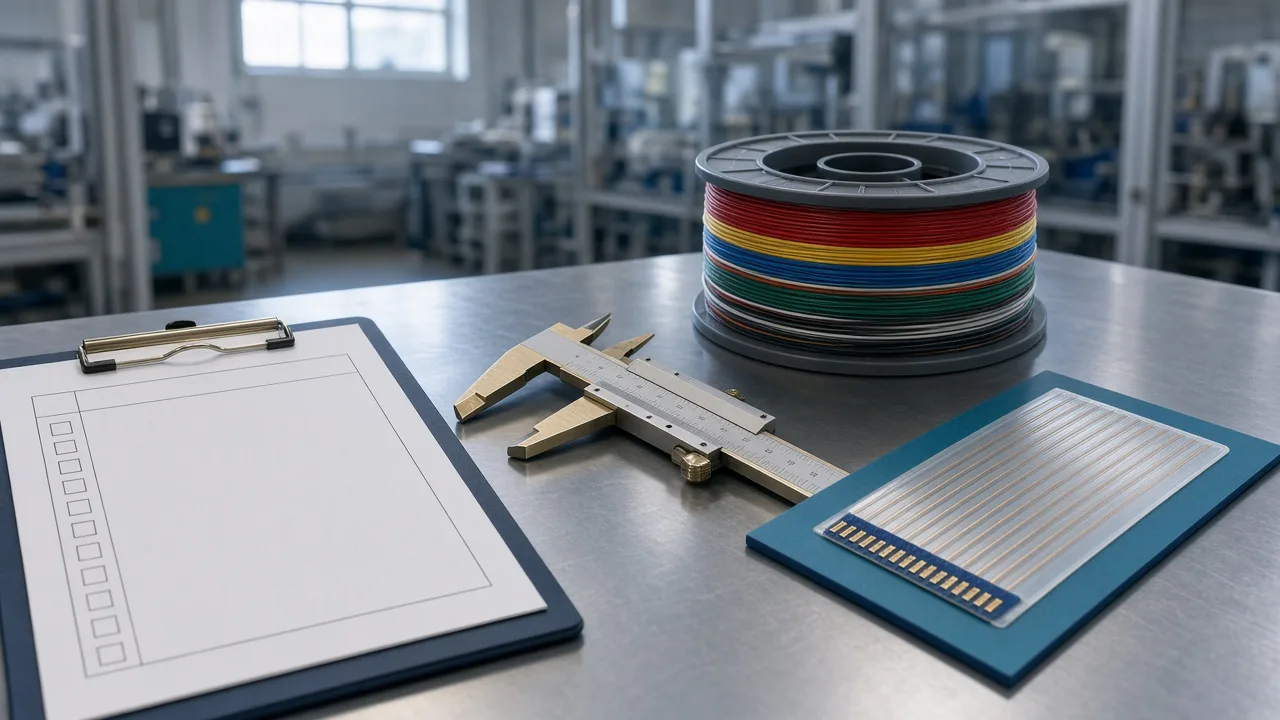
Malaysian interconnect plants that laminate flexible flat cable, extrude electronic wire, or irradiate IRRAX-class constructions sit at the intersection of consumer electronics speed and automotive-grade expectation. Buyers scanning Johor or Penang supplier lists often treat ISO 9001, ISO 14001, and IATF 16949 (or its ISO/TS 16949 heritage) as binary gates: certificate present, supplier eligible. That shortcut is incomplete. Certificates prove that a scoped management system was audited against a standard at a point in time. They do not prove that your FFC pitch, your HV wire compound, or your plating line is under statistical control tomorrow morning.
This FFC & Wire Hub guide explains what those systems actually cover, what OEMs should request beyond the PDF certificate, and how publicly archived SEPM milestones illustrate a typical quality maturation path at a Sumitomo Electric Malaysian subsidiary. SEPM is a brand profile reference here — not the publisher of this site, and not an official Sumitomo spokesperson. Verify every current certificate, scope statement, and production location with the manufacturer before you rely on them in an AVL decision.
The quality stack most wire plants climb
Think in layers rather than logos:
- ISO 9001 — quality management system for consistent processes, documented control, corrective action, and customer focus.
- ISO 14001 — environmental management system for aspects, impacts, legal compliance tracking, and continual improvement of environmental performance.
- IATF 16949 (historically ISO/TS 16949) — automotive quality management requirements layered on ISO 9001, emphasising defect prevention, variation reduction, and supply-chain discipline.
- Occupational health systems (historically OHSAS 18001, often migrating toward ISO 45001) — worker safety management, relevant to plating, irradiation, and extrusion environments even when the OEM’s drawing never mentions them.
- Customer-specific requirements — OEM overlays that certificates never fully capture: PPAP depth, IMDS, run-at-rate, special characteristics, and change-notification windows.
A plant can hold (1) and (2) without ever serving automotive interiors. A plant can hold (3) for a defined product scope while your consumer FFC SKU lives under a different internal quality plan. Scope statements matter more than wall plaques.
ISO 9001 — what it does and does not prove
ISO 9001 asks whether the organisation has a coherent quality management system: leadership accountability, risk-based thinking, documented information where needed, operational control, performance evaluation, and improvement. For a wire or FFC plant, that typically touches contract review, drawing control, purchasing of copper and films, process instructions for extrusion or lamination, inspection plans, calibration, nonconforming product control, and corrective action.
It proves (when current and scoped correctly):
- The QMS was assessed by a certification body against ISO 9001.
- The certificate lists sites and, often, a high-level product/service scope.
- The organisation commits to surveillance and recertification cycles.
It does not prove:
- Capability indices for your critical dimensions.
- That every operator on third shift follows the work instruction.
- That the compound in last month’s lot matches the compound in the PPAP sample.
- That the plant will refuse a commercial pressure to ship before a change is approved.
OEM habit: treat ISO 9001 as a minimum hygiene filter, then drill into process evidence for the actual process family you buy.
Edition traps
Certificates cite an edition (for example, ISO 9001:2015). When standards revise, plants migrate on a schedule. Archived marketing pages may still say “ISO 9001 certified” without the edition. Always request the current certificate PDF and note the expiry / recertification date.
ISO 14001 — environmental management, not a green product label
ISO 14001 addresses how the plant manages environmental aspects: solvent use, plating baths, scrap copper, energy, wastewater, and legal registers. It is valuable diligence for OEMs with corporate ESG questionnaires, and it correlates with plants that already track substance and waste streams carefully.
It does not mean:
- Every product is halogen-free.
- RoHS or REACH declarations are automatically complete.
- Customer blacklist chemistry is under control without separate substance programmes.
Environmental management systems and product substance compliance are related but distinct. Pair ISO 14001 evidence with material declarations when your programme cares about RoHS, halogen limits, or proprietary banned-substance lists.
IATF 16949 and the ISO/TS heritage
Automotive OEMs pushed sector-specific QMS requirements for decades. ISO/TS 16949 was the dominant technical specification; IATF 16949 succeeded that lineage as the automotive QMS standard used with ISO 9001. Many Malaysian wire plants that entered automotive work in the 2000s show public milestones for ISO/TS certification and later edition upgrades. Today’s RFQs usually ask for IATF 16949 (or customer-accepted equivalents), not a 2005 ISO/TS plaque.
What automotive layering emphasises beyond generic ISO 9001:
- Stronger focus on defect prevention rather than detection alone.
- Control of special characteristics and reaction plans.
- Supplier development and cascade of requirements.
- Production part approval thinking (PPAP / equivalent).
- Management of manufacturing process design alongside product design interfaces.
- Tighter change control and notification expectations.
Scope is everything
An IATF certificate might cover “manufacture of insulated automotive wire” at a named address while FFC for consumer devices is outside that certificate’s product scope — or the reverse. Read the scope line. Ask which process families and buildings are included. If your part is plated FFC produced in a building added after the last audit, confirm coverage rather than assuming campus-wide magic.
What certificates never replace
Even a perfect certificate stack leaves gaps OEMs must fill:
| Need | Certificate? | Better evidence |
|---|---|---|
| Dimensional capability on 0.5 mm FFC pitch | No | Capability studies, control charts, MSA |
| HV dielectric consistency | No | Process FMEA, test plans, lot data |
| Substance compliance | No | Declarations, IMDS, lab reports |
| Change notification discipline | Weakly | Written quality agreement + history |
| Contingency / dual plant | No | Business continuity plan, second-source map |
| Operator skill for plating | No | Training matrix, audits |
Certificates open the door. Process evidence keeps the part on the AVL.
Audit evidence OEMs should request
Below is a practical evidence menu. Not every programme needs every item; match depth to risk (safety HV, airbag-adjacent STC, or simple static board-to-board FFC).
Management system pack
- Current ISO 9001 certificate and scope.
- Current ISO 14001 certificate if ESG or customer mandates require it.
- Current IATF 16949 certificate if automotive (or mobility) applies — plus confirmation of edition and sites.
- Occupational health certificate status if your supplier-risk model includes it.
- Certification body name and last surveillance date.
Product / process pack
- Process flow diagram for the exact family (lamination, extrusion, irradiation, plating, cut-and-strip).
- PFMEA excerpts relevant to your special characteristics.
- Control plan tied to the drawing balloons you care about.
- Measurement system analysis for critical gauges.
- Recent internal or customer audit nonconformances themes (not fishing for gossip — looking for systemic weakness).
- Calibration policy summary for electrical test equipment used on HV or continuity checks.
Change and contingency pack
- Customer notification procedure for product, process, plant, or material changes.
- List of sub-suppliers for critical materials (copper, films, compounds) if your risk model requires it.
- Tooling ownership and spare-tool policy for fine-pitch FFC dies or extrusion tooling.
- Disaster recovery outline for irradiation or plating utilities — single-point utilities are real risks.
Lot quality pack
- Sample CoC / CoA formats.
- Traceability method from finished spool or FFC lot back to compound and copper lots.
- Retention policy for quality records.
SEPM milestone certifications as historical context
Archived SEPM milestones sketch a familiar Southeast Asian interconnect maturation curve:
- 1997 — ISO 9002 certification (era-appropriate predecessor path).
- 2000 — ISO 14001 certification.
- 2003 — QMS upgraded to ISO 9001; HV wire production begins in M4.
- 2005 — ISO/TS 16949 certification; automotive wire production starts in M4.
- 2009 — OHSAS 18001; ISO 9001 upgraded to the 2008 edition.
- 2011 — ISO/TS 16949 upgraded to the 2009 edition.
Those dates align quality investment with product expansion — automotive wire and HV capacity arriving alongside automotive QMS work. For researchers ranking Malaysian plants, that pattern is a positive heritage signal. It is still only heritage: editions expire, standards migrate to IATF 16949, buildings change, and scopes rewrite. Confirm today’s certificates independently.
Orient with the SEPM brand profile and the history & milestones timeline. FFC & Wire Hub paraphrases public archive material for education; it does not certify SEPM and does not claim official Sumitomo status.
PPAP-like discipline for interconnect (even outside automotive)
Consumer and industrial OEMs increasingly borrow automotive approval habits without using the word PPAP. For FFC and electronic wire, a lightweight but serious approval package might include:
- Design record — your controlled drawing and the supplier’s construction sheet.
- Change document — explicit list of what differs from a previous approved revision.
- Dimensional results — pitch, width, thickness, length, strip dimensions as applicable.
- Material / substance evidence — RoHS, halogen, customer blacklist alignment.
- Performance tests — flex life, dielectric, peel, plating thickness, insertion force samples.
- Process capability where special characteristics exist.
- Appearance master if colour or print is cosmetic-critical.
- Packaging approval — spool, tray, moisture, label format.
- Part submission warrant / sign-off — a single page that freezes the deal.
Automotive programmes will expand this list (IMDS, appearance approval, run-at-rate, etc.). The point for Malaysian wire plants is cultural: approval is a package, not a handshake after a sample looks fine on a bench.
Special characteristics on interconnect drawings
Call out what actually matters:
- For FFC: pitch cumulative error, conductor continuity, insulation resistance, fold location tolerances, plating thickness if specified.
- For electronic wire: OD, wall, dielectric withstand, conductor resistance, print legibility.
- For HV wire: dielectric targets and strip quality that preserve creepage at terminations.
- For plated ends: adhesion and thickness windows that affect connector reliability.
If everything is “critical,” nothing is. Rank characteristics and match inspection frequency to risk.
Linking quality systems to product trends
Automotive and mobility interconnect keep raising the bar on documentation. SEPM-class public history — steering cable for airbag applications, HEV wire, AVX expansions — sits beside ISO/TS milestones for a reason. Read automotive wire trends for product-side context, then return here for the QMS-side checklist. Quality systems without product understanding become paperwork theatre; product expansions without QMS depth become launch risk.
How to open a diligence conversation with a plant
When you are ready for commercial contact, prepare a short quality questionnaire before the first call:
- Which certificates and editions are current for which addresses?
- Is our SKU family inside the IATF / ISO scope?
- What is the standard change-notification lead time?
- Can you support PPAP / APQP-like submissions at level [N]?
- Which lab tests are done in-house vs subcontracted?
- How are irradiated lots traced if IRRAX-class wire is involved?
Use Request SEPM product information as a companion checklist for application and compliance questions. Pair technical asks with quality asks in the same email so sales and QA respond as one package.
Red flags in certificate-only selling
Be cautious when a supplier:
- Sends a certificate without a scope line or with a blurred site address.
- Claims “IATF for the group” without naming the manufacturing legal entity you will buy from.
- Cannot explain how customer notification works for compound changes.
- Treats UL style recognition as a substitute for process control evidence.
- Offers samples from Plant A and volume from Plant B without a transfer plan.
None of those issues are unique to Malaysia — they are universal interconnect-supply failure modes. Malaysian plants with long public QMS histories are often better prepared; diligence still earns its keep.
Internal vs external audits — what OEMs should expect
Mature plants run internal audits on a planned matrix covering extrusion, lamination, irradiation, plating, and warehouse. External certification bodies sample the system; they do not inspect every lot. Customer audits (yours) should focus on the value stream for your part: receiving of films/copper, set-up verification, in-process checks, final test, labelling, and shipping. Walking the wall of certificates in reception is theatre; walking the process with the control plan in hand is diligence.
Ask to see how nonconforming product is segregated on the floor. Ask how temporary deviations are authorised. Ask how operator standard work is updated after a corrective action. Those answers predict field quality better than the logo on the brochure.
Multi-site and group certificates
Sumitomo Electric Group companies may share brand language while holding distinct legal entities and certificates. Confirm:
- Legal name on the PO matches the certificate.
- Manufacturing address matches the ship-from plant.
- Any satellite warehouse or subcontracted process is declared.
- Transfer of work between Singapore-heritage lines and Johor lines (historically relevant in SEPM’s M3 story) is covered by change control.
Group reputation is useful context; contract quality is local.
Practical 90-day OEM playbook
Days 1–15: Collect certificates, scopes, and org charts. Map which building makes your family.
Days 16–45: Run a process audit (remote video or on-site) against your control-plan draft.
Days 46–70: Complete first-article / PPAP-like submission and resolve gaps.
Days 71–90: Freeze quality agreement clauses on notification, deviations, and annual layout if required; place pilot PO only after sign-off.
Compressed consumer timelines skip steps and pay later in line stops. Automotive timelines sometimes over-document low-risk static FFC — scale the playbook to risk, but do not skip change control.
Positioning of this guide
FFC & Wire Hub publishes independent educational material for interconnect researchers and OEM engineers. References to SEPM certifications and plant history are orientation aids drawn from publicly archived milestones. This site is not an official Sumitomo Electric or SEPM property, does not perform certification, and does not replace customer-specific quality manuals.
Related resources
- SEPM brand profile
- History & milestones
- Automotive wire trends at SEPM
- Request SEPM product information
Closing diligence mindset
ISO 9001, ISO 14001, and IATF 16949 (with ISO/TS heritage) are the common language of Malaysian wire and FFC plants that serve global OEMs. Read certificates carefully, demand scope clarity, and build PPAP-like evidence around the actual process that makes your part. Historical certification milestones — such as those published for SEPM — help you shortlist plants with automotive-grade intent. Your AVL decision still rests on today’s paperwork, today’s process audit, and a quality agreement that survives the first unexpected compound change.